Commercial Palm Trimming and Tree Removal in Orlando
What happens when palms are planted too close to a commercial building?
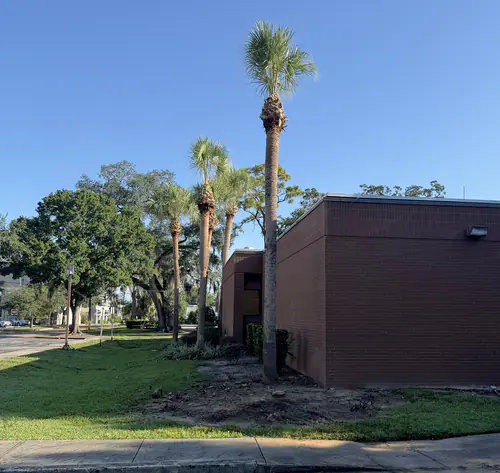
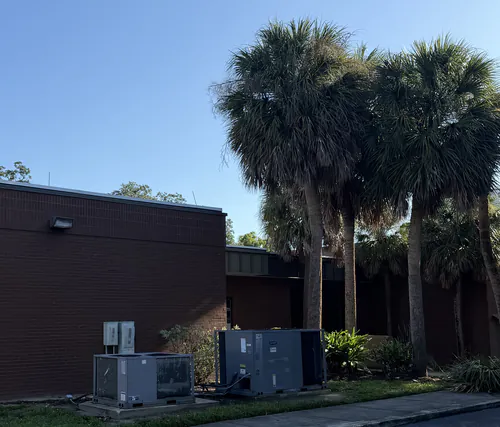
They stop being landscaping and turn into a maintenance bill. The before photo shows the situation we were called for: a tight row of sabal palms in the narrow bed between the brick wall and the curb, crowns grown out over the two condensing units on the concrete pad, with the electrical meters and disconnects sitting right behind them. Dead fronds hung over the equipment. Seed stalks dropped fruit down onto the pad and into the coil fins. Nobody planned this. Someone planted young palms against a wall years ago when they were four feet tall and looked right, and the palms did what palms do. A sabal does not thicken with age the way an oak does, so the trunk stays roughly where it started and it is the crown that moves, spreading out toward whatever is beside it as the palm gains height. On a commercial site that is the roof edge, the mechanical equipment and the walkway. Tree removal settles it once instead of every spring.
How do you decide which palms come out and which ones stay?
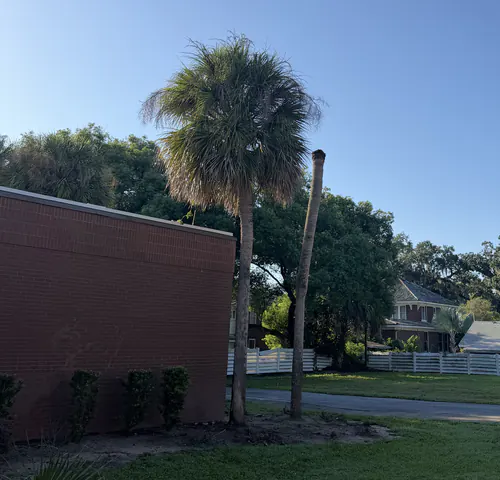
Distance from the building decides it, not the condition of the palm. Everything in that row was healthy. The problem was geometry. The ones nearest the wall stood close enough that no amount of trimming would hold the crown off the brick and the roofline for more than a season, so those came out. The middle photo catches one mid job, crown already off, bare trunk still standing and waiting to be sectioned down. Palms are quick to take down and completely unforgiving about where the trunk lands, because there is no branch structure to rig from and no second chance once it is moving. So the crown comes off first, then the trunk drops in short controlled pieces toward the open grass rather than toward the wall, the AC units or the sidewalk. The palms with room stayed and got cleaned up. That is the whole call. A crew that removes everything is being lazy, a crew that trims everything will be back next year, and the property pays either way.
Why does commercial tree trimming in Orlando take more planning than a residential job?
Because the property keeps operating while the crew works. A homeowner can give up their driveway for an afternoon. A business cannot give up its entrance, its parking or its air conditioning in August, and on this site all three sat within a few steps of the drop zone. Those condensers run all day. Lay a frond across the top of one and you have restricted airflow through the coil, which the tenant feels as a warm building and a higher bill long before anyone connects it back to the tree crew. So the units get covered before anything comes down, debris gets pulled off as it lands instead of raked up at the end, and the meters on the wall stay clear the entire time. The curb line matters just as much. There is a public sidewalk running past this corner and a stop sign at the intersection, which means pedestrians and stopped traffic are part of the drop zone whether you planned for them or not. Roeling Green Lawns prices commercial work with that sequencing already built in, the same way we ran the commercial palm trimming at an Osceola County clinic.
What does trimming a sabal palm the right way actually mean?
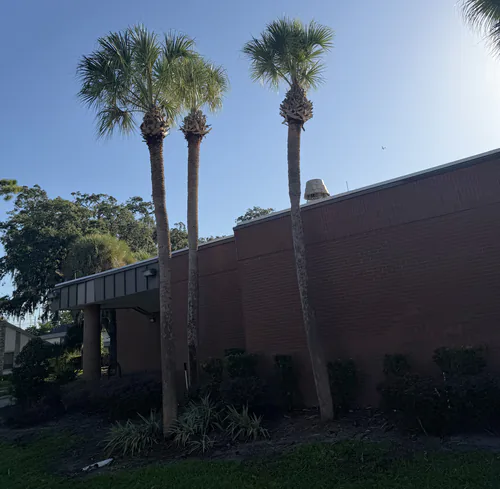
Taking the dead fronds, the old leaf bases and the seed stalks, then stopping. Sabal palmetto is Florida's state tree and it is built nothing like the oaks around it. There is one growing point, sitting in the center of the crown. Damage that bud and the palm is finished, because no dormant buds are waiting further down the trunk to push out replacement growth. The green fronds are also a bank. Florida sand holds potassium poorly, so a palm draws potassium out of its oldest fronds to build the new ones, and cutting healthy green material off removes that reserve early. The palm compensates by pulling harder on what is left, and you end up with the look you see on properties all over Central Florida: a small tuft on a long bare trunk, yellowing at the frond tips, less stable in wind than before anyone touched it. The working rule is the nine and three line, meaning nothing above horizontal comes off. These palms finished tighter than a palm out in a landscape island would, since clearance from the brick and the roof edge was part of the job, but that line and the bud are where tree trimming stops.
How often should an Orlando commercial property have its palms serviced?
Once a year handles most sabal palms, and twice is the honest answer for any palm hanging over parking, a doorway or mechanical equipment. The difference has nothing to do with the health of the palm. It is about what sits underneath it. A sabal frond is heavy at the base, stiff as a board, and it lets go from thirty feet with no warning. Over grass, that is nothing. Over a condenser, a windshield or somebody's shoulder on the way through the door, it is an incident report. Seed stalks are the other half of it, since they ripen and drop fruit that stains concrete and leaves a walkway slick after an afternoon storm. Both of those are predictable, so both can be scheduled. What a property manager actually wants is one line item and a crew that already knows the site, knows where the equipment sits and knows who to call inside the building. There is a similar commercial job in the tree trimming at a Melbourne Publix, and plenty more in our completed projects.
A closer look
Are the palms at your property growing into the building?
Call us at (321) 436-1675 for a free site walk, fully insured commercial trimming and removal, and a property left cleaner than we found it.