Landscape Design and Installation in Central Florida
Landscape design in Central Florida has to survive sand, salt, summer storms and the shade under a live oak. We design and install beds, palms, pavers, lighting and sod as one plan, with one crew, across Volusia, Lake and Seminole counties.
Where does a good landscape design start?
With the yard itself, before any plant list. We look at where the big trees throw shade, how water moves across the lawn after a storm, and which sightlines matter from the street and the driveway. Then we count sun. Stand in the bed at midday and count the hours of direct light it actually gets, because anything that demands full sun will stretch and sulk in a spot that only sees three.
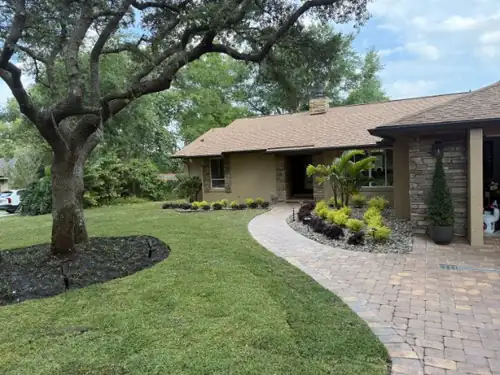
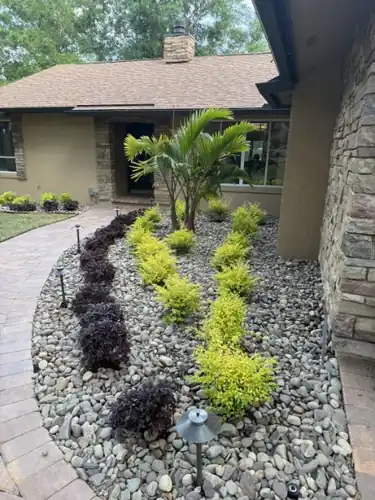
That's how the Lake Mary front yard came together. An oak shaded half the lot, so the plants were picked to hold their shape in part shade, and the oak got a smooth mulch ring so it reads as a feature instead of an obstacle. Curving bed lines, accent palms at the entry, and golden green shrubs against deep burgundy ones gave it real contrast instead of a flat wall of green. You can see the full result in our front yard landscape design in Lake Mary. At Roeling Green Lawns, the design and the install come from the same crew.
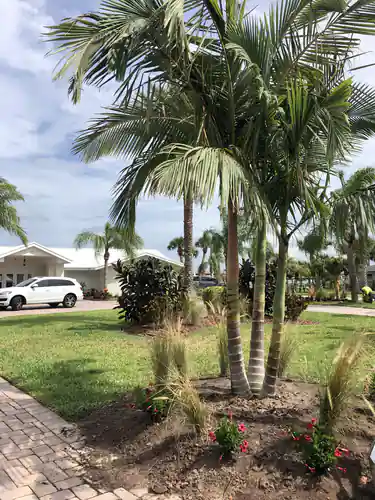
Which plants hold up in a coastal Florida yard?
Plants that can take salt, wind and sand, in that order. Salt drift reaches yards a few blocks back from the beach, not just oceanfront lots. Coastal sand drains beautifully and holds almost nothing, so anything that needs rich, damp soil is a waste of money there. The UF/IFAS Florida Friendly Landscaping program sums it up as right plant, right place, and on the coast that decides everything.
The New Smyrna Beach bed we installed used Christmas palms for structure and muhly grass, which is genuinely salt tolerant and throws a pink haze of seed heads every autumn. Orange bromeliads (Aechmea blanchetiana) handle full sun and salt. White bird of paradise went along the back for height, with pentas at the front for flowers and pollinators. It's a list we've been planting along this coast since 2007, and it's all in our coastal front yard landscape design in New Smyrna Beach. Grasses and color fill in within about one growing season. Palms take two or three years.

How do you plant a landscape bed under a live oak?
Carefully, and mostly by hand. An oak's feeder roots sit in the top foot of soil, right where a new bed goes. So no tilling. We don't raise the grade either, and we don't cut roots we don't have to. Planting holes get dug individually by hand, and if a hole hits a substantial root, the hole moves. The plant list leans toward things that tolerate root competition and dry spells, because the oak will win every fight for water.
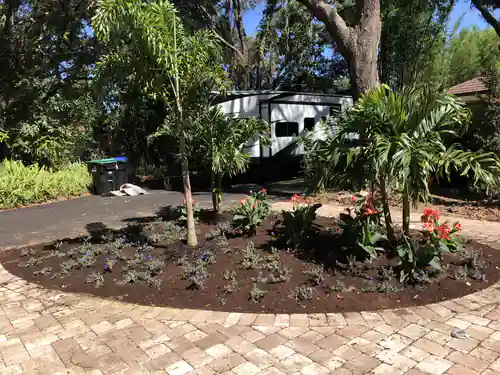
The Winter Garden job was a circular island bed in a paver turnaround with an RV pad, cut as a full circle to match the pavers and planted in a single day. Canna lilies went through the middle for height and red flowers, silver foliage low around the front edge, and young palms were set to grow up into the gap under the canopy. That bed also screens the parked RV. Good landscape design in a driveway is mostly scale and sight lines, as our driveway island landscape bed in Winter Garden shows. Some cities protect trees in their code, so confirm before any grading or hardscape inside an oak's root zone.
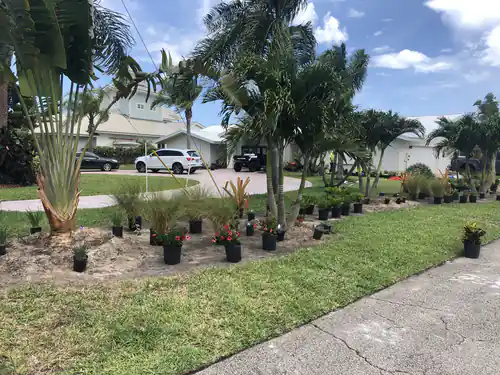
Why stage every plant in its pot before planting?
Because nobody reads a planting plan, and everybody understands a yard full of pots. Before we dig anything, every plant gets stood up in its final position, still in its nursery pot. The palms go first and everything else is arranged around them. Then we walk out to the street. We look at it the way a neighbor or a buyer will. Spacing reads completely differently on the ground than it does on paper, and sliding a pot two feet to the left beats digging a plant back up.
This is also where we talk you out of planting too tight. A bed planted to look completely full on day one will be overgrown within three years, crowding itself and needing constant hacking back. So we leave gaps on purpose and space for what the plants will become. It takes an extra half hour on install day. It saves years of fighting the bed afterward, and it's the single step that makes a new landscape look intentional instead of stuffed.
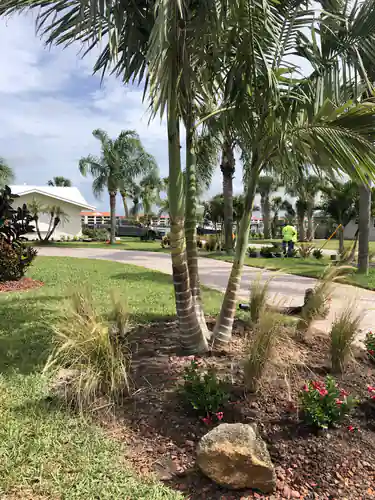
How much mulch does a new Florida landscape bed need?
Two to three inches, kept off the stems and palm trunks. Never more. Mulch piled against a trunk holds moisture right where rot starts. We generally use hardwood or pine bark mulch. Cypress is worth a second thought, since it comes from harvesting cypress trees, while melaleuca mulch is a reasonable alternative because its source tree is invasive in Florida. Plan on topping it up once a year as it breaks down.
Landscape fabric helps at the edges of a bed, especially along a driveway or a street on a windy lot, but it is not a weed cure. Weeds seed into the mulch on top of it anyway. What a new bed really needs in its first thirty days is proper water, every plant soaked in and kept moist while the roots move out of the nursery soil into the sand. A zoned system set up for beds rather than turf does that best, which is where irrigation installation and repair comes into a landscape job.
Can landscape design include pavers, lighting and sod?
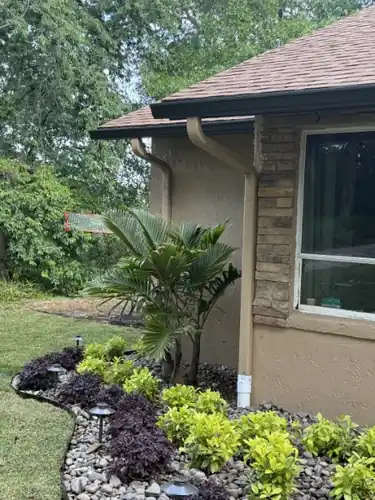
It should, because they work best planned together. At the Lake Mary home, the paver walkway in warm earth tones got a soldier course border and sits against a river rock bed with low voltage landscape lighting. The sod was edged cleanly against the new mulched beds, and the grade was set for the turf before the walkway was prepped. Sod, beds, palms, lighting and hardscape weren't bolted on one at a time.
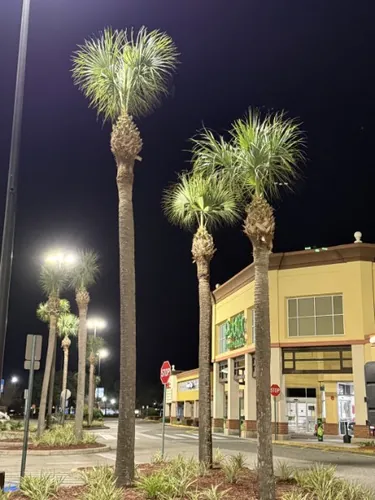
We handle the whole scope in house, from design and demolition through sod installation, planting, mulch, lighting and pavers, so there's one crew and one accountable contractor instead of four trades pointing at each other when something doesn't line up. The same goes for commercial work. For a DeLand shopping center we planted sabal palms in the parking islands overnight. Sabals handle the heat bouncing off asphalt, and their roots stay tight, so they won't buckle the parking lot.