Palm Tree Removal With a Crane in Deltona
Why does a palm this tall need a crane instead of a bucket truck?
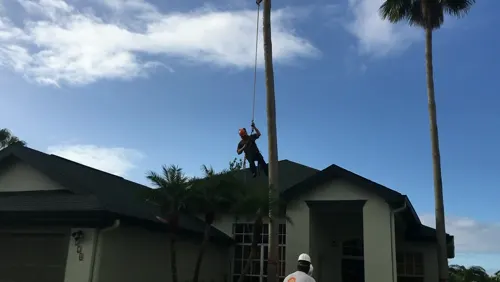
Because nothing on a normal truck reaches the top of it. Deltona was platted by the Mackle Brothers in the early 1960s, and the Washingtonia palms that went in with those first houses have had sixty years to run. A mature Mexican fan palm can pass 80 feet. Most residential bucket trucks work somewhere in the 55 to 75 foot range, and even when the boom technically reaches, you are working at full extension over a roof with no room to swing. So a climber goes up first. He is spiked in, tied in, and his only job on that trip is to set the rigging line at the top of the trunk before a saw touches anything. That line is what the crane hooks to. Placing it correctly matters more than the cutting does, because the pick point decides which way the trunk travels once it comes free. Everything after that is controlled weight. This is how we run tree removal work anywhere in our tree service in Deltona area when a tree is tall, close to a structure, and has nowhere to fall.
How does the trunk get out without touching the house?
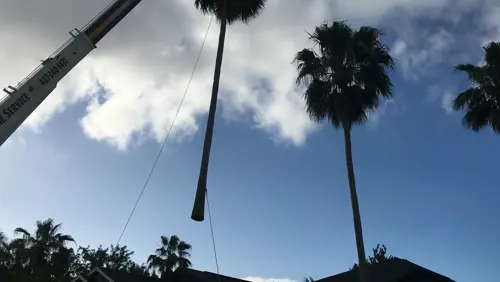
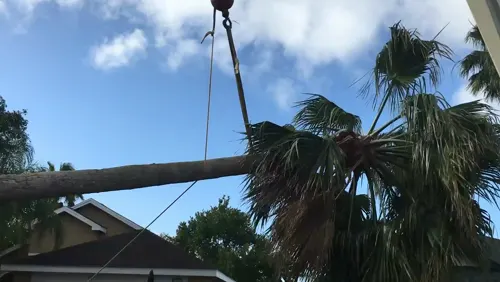
It never lands on the property at all. Once the climber is clear, the crane takes up slack until the line is loaded, the cut goes in below the rigging point, and the section lifts straight up before it swings anywhere. Watch the trunk in the clip. It hangs dead vertical and barely moves, which is exactly what you want, because a piece that is swinging is a piece nobody controls. The operator then flies it out over the roofline and down to the street, where a groundman is waiting at the trailer. Palm trunks are heavier than people expect. Washingtonia wood is dense, wet and stringy, and a long section of mature trunk runs well into the hundreds of pounds. That weight is the entire argument for the crane. Dropping it was never an option here with a roof and a screen enclosure underneath, and a standard Deltona quarter acre lot with the house set where it sits does not give you a landing zone anywhere.
Are climbing spikes ever acceptable on a palm?
Only on a palm that is coming down. You can see the climber gaffed into the trunk in the first clip, and that is the right call here because this tree is being removed. On a palm you intend to keep, spikes are a mistake. Palms are monocots. They have no vascular cambium and they do not compartmentalize wounds the way an oak does, so every spike hole stays in that trunk permanently and opens a door for pathogens. UF/IFAS says the same thing in its palm pruning guidance. Ask any company quoting you a trim whether they plan to spike the tree, and if the answer is yes, keep calling. At Roeling Green Lawns we climb removals on gaffs and we work trims off a lift or a rope and saddle. It is a small distinction that stays visible on the trunk for the rest of the palm's life, which in central Florida can be another forty years.
What actually kills a mature palm in Deltona?
Usually disease, not wind. Two of them are worth knowing by name if you own palms in Volusia County. Ganoderma butt rot shows up as a shelf shaped conk near the base of the trunk, there is no treatment for it, and by the time the conk appears the trunk is already compromised from the inside out. Lethal bronzing is the other one. It moves through central Florida in cabbage palms, queen palms and date palms, drops the fruit early, browns the lower fronds upward and kills the palm within months of the first symptoms. Neither gets better. If a palm had Ganoderma, do not plant another palm in the same hole, because the fungus persists in the soil there. That is worth asking about before you spend money replacing a tree in the same spot. We would rather tell you a palm is finished than sell you a trim on something that will be dead by spring.
What is left in the yard when the crew pulls out?
Bare grass and a stump ground below the surface, with the fronds, the trunk sections and the chips gone on the trailer. Nothing gets stacked at the curb. Volusia County yard waste collection is not built for palm trunks, and a homeowner who takes a cheaper price with a haul away exclusion buried in it usually finds that out a week later. We take it with us. The other thing worth knowing is what the ground under a removed palm looks like, because palms grow from a shallow root initiation zone rather than a taproot, so the disturbance is wide instead of deep and the spot settles over the next few rainy weeks. Plan on topping it with soil before you sod. If you want to see how a hardwood runs in the same city, the front yard oak removal in Deltona went a different way entirely, and there is more in the rest of our completed projects.
A closer look
Is there a palm in your Deltona yard that nobody wants to climb?
Call us at (321) 436-1675 for a free look at the tree, fully insured removal, and a crane on site when the job calls for one.