Driveway Island Landscape Bed in Winter Garden

What problem does a driveway island bed actually solve?
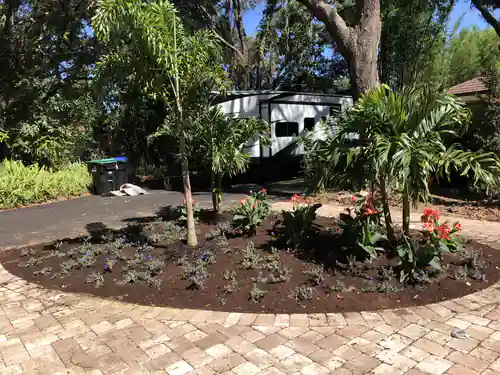
It turns dead space into the first thing anybody sees. The paver circle at this Winter Garden home is a turnaround with an RV pad off one side, and the middle of it was doing nothing except being driven around. A planted island fixes three things at once. It gives the driveway a reason to be that shape, it screens the parked RV from the front of the house, and it puts colour at eye level from the road without touching the lawn. The bed got cut as a full circle to match the pavers, dug out, filled and planted in a single day, with canna lilies through the middle for height and red flower, silver foliage low around the front edge, and young palms set to grow up into the gap under the oak canopy. Nothing here is high maintenance. That was the brief. Good landscape design in a driveway is mostly scale and sight lines.
What can you plant under a mature oak canopy?
Less than the catalogue suggests and more than most people try. The canopy over this bed is mature live oak, and it changes two things, light and water. Dappled shade suits a long list of Florida plants. The roots are the real competition, because an oak's feeder roots sit in the top foot of soil and spread well past the drip line, and they will take whatever irrigation you put down before your new plants get near it. So the plant list leans toward things that tolerate root competition and dry spells. Cannas take the shade and reward extra water, silver foliage holds up in the leaner spots, and the palms are there because they cope with an overstory better than most understory shrubs. Anything demanding full sun will stretch and sulk. The honest test is to stand in the driveway at midday and count how many hours of direct light the middle of that circle really gets.
How deep should the mulch go, and what kind?
Two to three inches, and keep it off the stems. That is the whole rule and it gets broken constantly. Mulch deeper than about three inches starts shedding water instead of holding it, and mulch banked against a trunk or a stem traps moisture exactly where the bark needs to stay dry, which is how you get rot on a plant that was perfectly healthy when it went in. You can see the finished depth in the photos, dark and even across the bed with a clean gap around every plant. On type, Roeling Green Lawns generally uses a hardwood or pine bark mulch here. Cypress is common in Florida and worth a second thought given where it comes from, and melaleuca mulch is a reasonable alternative because the tree it is made from is an invasive the state is actively trying to remove. Whatever you choose, plan on topping it up annually. Mulch is a consumable, not a fixture.
What do you have to avoid doing around oak roots?
Do not till, do not raise the grade, and do not cut roots you do not have to. Those three cover almost everything that kills a mature oak years after somebody landscaped underneath it. Running a tiller through a bed under a canopy shreds the fine feeder roots the tree lives on. Bringing in six inches of fill to level a bed buries the root flare and suffocates what is underneath, and the tree does not die that season, it declines slowly enough that nobody connects the two events. So the planting holes here were dug by hand, individually, and the existing grade was left exactly where it was. If a hole hits a substantial root, the hole moves. It is slower, and it is the difference between a bed that looks good for twenty years and a bed that quietly costs you an oak. We have removed enough declining trees through our tree service to know how often landscaping and construction turn out to be the cause.
Does Winter Garden regulate what happens under those trees?
Yes, and it is worth checking before doing anything structural under a canopy. The City of Winter Garden carries tree protection provisions in its code, and like most Orange County municipalities it treats significant trees on private property as something you cannot simply remove or damage at will. Planting a bed is not the same as removing a tree. Grading, root cutting and hardscape work inside a protected tree's root zone can absolutely fall under it though, so confirm the current requirements with the city rather than assuming, since codes are revised regularly. The practical version for a homeowner is short. Plant into the existing grade, hand dig, keep pavement out of the root zone, and ask first if you are thinking about taking anything down. There is a comparable bed installation in the landscape design in Lake Mary, and more in our completed projects.
Is there a patch of your Winter Garden yard doing nothing at all?
Call us at (321) 436-1675 for a free walk through, a plant list that suits the light you actually have, and a bed installed in a day.