Tree Removal Inches From a Daytona Beach Home
How do you take a tree down with no room to drop anything?
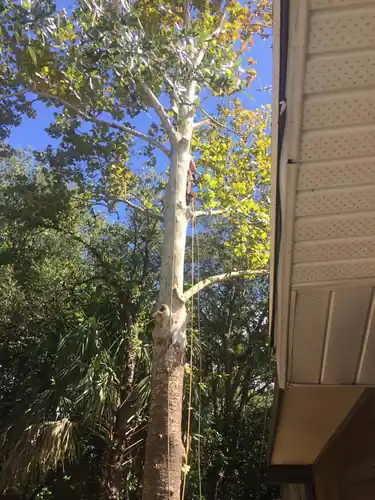
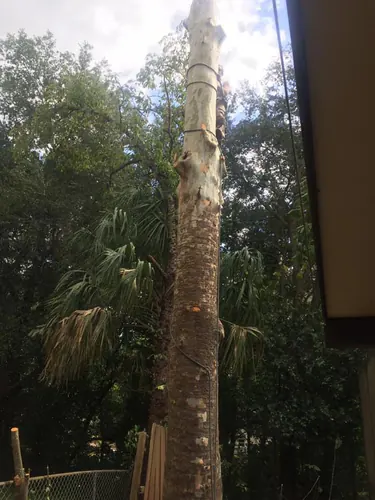
One piece at a time, on a rope, with a groundman guiding every one of them. The first photo shows the problem better than any description can: the trunk is close enough to the eave that a hand on the bark touches the soffit. There is no felling cut anywhere in this job. A climber goes up, ties in, and takes the top out in sections small enough to be lowered rather than dropped, and each piece is rigged so it swings away from the house instead of into it. The second photo is midway through, crown gone, bare stem stripped and roped ready to come down in lengths. Slow is the point. Work like this gets measured in how little happens rather than how fast, and a crew in a hurry beside somebody's siding is a crew you do not want on the property. That is the core of any tree removal in a tight spot.
Where does the wood go when no machine can reach the yard?
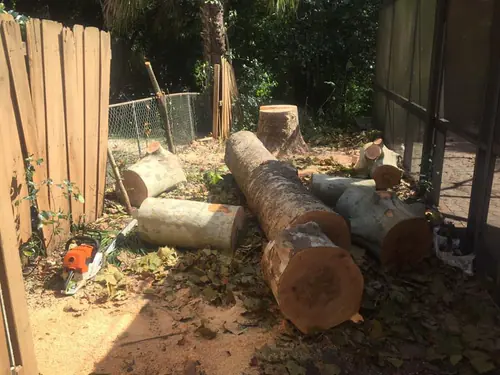
Out by hand, round by round. Look at the third photo and count the constraints: a wood privacy fence down one side, chain link across the back, and the screen enclosure wall on the other, with roughly the width of a wheelbarrow between them. No skid steer fits through that. So the trunk gets bucked into rounds a person can actually lift, stacked where they were cut, and carried out to the truck at the front of the property. It is the slowest part of the day and it never appears in the photos anybody posts. Access is the single biggest variable in what a removal costs, and it is why two identical trees on two different streets in our tree service in Daytona Beach area can quote completely differently. If a truck can back to the tree, the wood is gone in twenty minutes. If everything comes out through a three foot side gate, it does not.
Should a tree growing against a wall be trimmed or removed?
Removed, once the trunk itself is against the structure. Trimming solves a canopy problem. It cannot solve a trunk that is going to keep expanding into a wall, and a tree this close only gets closer, because the stem adds diameter every year and the roots underneath are doing the same thing to the footing and the slab. There is also nowhere for roots to develop on the house side, which leaves the tree structurally lopsided even when it looks fine from the street. The honest test is simple. If the reason you want it trimmed is that it is touching the house, trimming is a delay rather than a fix. We would rather say that up front than take money for a trim you will be calling about again in two years. Roeling Green Lawns quotes plenty of trims where trimming is genuinely the right answer, and this was not one of them.
What does a screen enclosure change about the job?
It sets the entire rigging plan. A pool cage looks tough and is not. The frame is aluminium, the panels tear if you look at them wrong, and rescreening a two story enclosure costs real money, so nothing is allowed to touch it at any point. That means every piece coming off the tree has to be under control from the moment the saw finishes the cut, which is exactly what the ropes in the second photo are doing. The other thing an enclosure does is take away your landing zone. A yard that would otherwise give you somewhere to put a limb is now roofed over, and the only clear ground left is the narrow strip along the fence. Ask any company quoting this kind of work how they intend to protect the cage. If the answer is vague or the price is suspiciously low, that is your answer.
Do you need a permit to remove a tree in Daytona Beach?
Very likely, and the city is where to confirm it. Daytona Beach regulates tree removal through its land development code, with the requirements depending on the size of the tree, the species, and whether the property is residential or commercial. Check the current rules with the city before scheduling rather than afterwards, because these ordinances get revised. Florida statute 163.045 is the other piece worth understanding. It allows a residential owner to remove a tree without local permits or fees where documentation from an ISA certified arborist or a licensed Florida landscape architect establishes that the tree presents an unacceptable risk. Read it carefully before relying on it. It is narrower than the internet suggests, it applies to residential parcels, and the documentation has to exist first. For a genuine hazard case like this one, it is a reasonable route. There is a similar job in the moss laden oak removal in Daytona Beach, and more across our completed projects.
A closer look
Is there a tree growing into the side of your Daytona Beach home?
Call us at (321) 436-1675 for a free look at the access, fully insured removal, and every piece lowered rather than dropped.