Removing a Moss Laden Oak at a Daytona Beach Home
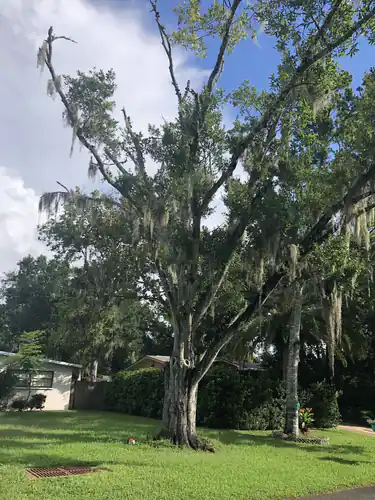
What does the yard look like once an oak that size is gone?
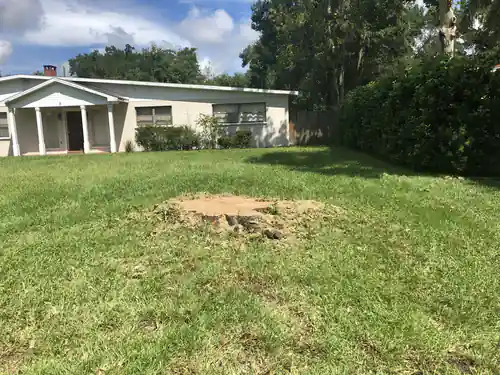
Bigger than the owner expected, and that is the part nobody warns you about. The second photo is the same front yard after the tree came out and the stump was ground, and the first thing people notice is the light. A canopy that wide was shading the entire front of the house, and once it is gone the lawn underneath sits in full sun and the house reads differently from the street. The grinding leaves a low mound of chips and soil where the trunk was, which settles and then gets topped and turfed. The rest of the yard came through clean, because the drop zone was open grass rather than anything that could be damaged. That is the straightforward version of this work. Where a tree has room to be sectioned into open lawn, a tree removal is an uncomplicated day. It is the trees with nowhere to go that get expensive.
Does Spanish moss kill the tree it is hanging on?
No. Spanish moss is an epiphyte, not a parasite, and this is probably the most persistent myth in Florida tree care. Tillandsia usneoides puts no roots into the host at all. It pulls water and nutrients out of the air and rain and simply uses the branch as somewhere to hang. You will see it draped through perfectly healthy live oaks across every neighborhood we visit for tree service in Daytona Beach. That said, it is not meaningless. Moss builds up fastest on trees with thin, open canopies, because more light reaches the interior branches, so a tree absolutely smothered in it is often a tree that has been declining for a while already. The moss is the symptom rather than the cause. Heavy loads do add weight and wind sail to limbs that are already weak, which counts for something on a storm coast. But nobody should be selling you a removal on the strength of the moss alone.
So what actually made this oak a removal?
Position and condition together. This oak stood in the front yard of a Daytona Beach home with its canopy reaching over the roof and the driveway, and the crown had thinned to the point where the moss was the densest thing in it. Deadwood through the upper limbs, sparse foliage, and a canopy that had stopped filling in are the pattern you look for. Add a target underneath and the calculation changes completely. A declining tree over open pasture is a tree you can leave alone and keep an eye on. The same tree over a bedroom, in a county that took direct hits from Ian and Nicole in 2022, is a different conversation, and most homeowners here have already had it once. Roeling Green Lawns will talk you out of a removal when the tree is worth keeping. This one was not on that list.
What does stump grinding leave behind in the ground?
Wood chips, and more of them than the hole appears to need. A grinder chews the stump and the buttress roots into coarse chips mixed with soil, and because chipped wood takes up more volume than solid wood, the spot ends up mounded rather than level. Standard depth is a few inches below grade, deep enough to grass over and to get a mower across without hitting anything. What you cannot do is leave the chips in place and expect a lawn. Fresh wood chips tie up nitrogen as they break down, so grass planted straight into them comes in yellow and thin and stays that way for a season. The fix is simple. Scrape most of the chips out, backfill the hole with topsoil, let it settle through a couple of rains, then sod or seed. Ask whether grinding and chip removal are both in the quote, because they are very often separate lines.
Is a permit needed to take an oak out in Daytona Beach?
Probably, and the city is where you confirm it. Daytona Beach regulates tree removal through its land development code, with requirements depending on tree size, species and property type, so check the current rules with the city before scheduling rather than after. Florida statute 163.045 is the other route worth understanding. It lets a residential property owner remove a tree without local permits or fees where documentation from an ISA certified arborist or a licensed Florida landscape architect shows the tree presents an unacceptable risk. It is a real exemption and narrower than it sounds online, because the documentation has to exist first and it applies to residential parcels. For a declining oak over a house, that is a legitimate path. We ran into similar constraints on the tree removal inches from a Daytona Beach home, and more of this work sits in our completed projects.
Has an oak over your Daytona Beach roof started thinning out?
Call us at (321) 436-1675 for a free honest assessment, fully insured removal, and stump grinding quoted up front rather than added later.